
YouTube: https://www.youtube.com/watch?v=3jPFUkaPKCc
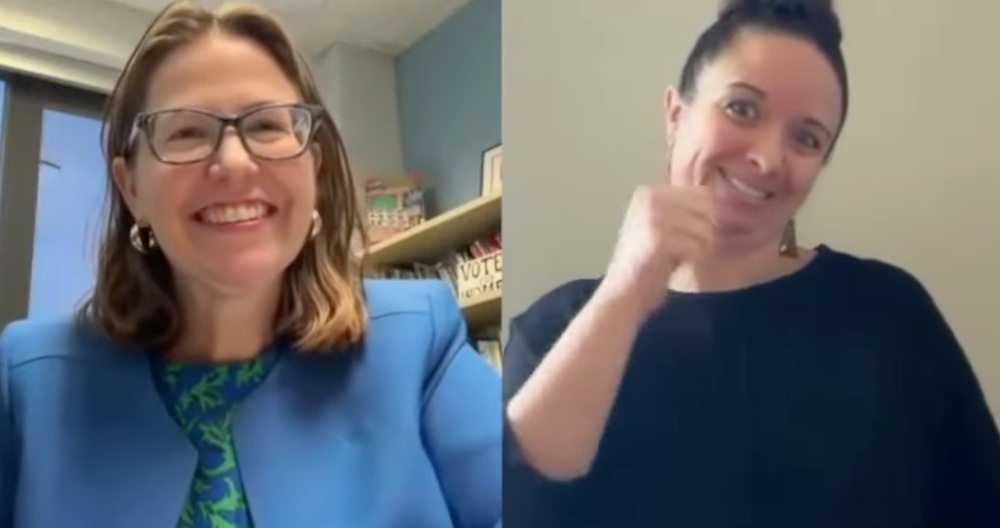
Renca Dunn interviews Tawny Holmes Hlibok, a longtime Deaf education advocate who runs the @DeafEducation Instagram page. Tawny explains that the US Department of Education is accepting public comments on IDEA’s Least Restrictive Environment approach and encourages Deaf community members to share their experiences. She said this is a rare opportunity. Tawny said the IDEA (Individuals with Disabilities Education Act) ever since it was established about 50 years ago, had an immense impact on our children, education, and communities in determining where they go to school.
IDEA generally aims to send children to mainstream settings. This works for many, including some deaf and hard of children, but many deaf children struggle with this. They don’t have language access or opportunities to meet and talk with a deaf or signing teacher. They’re often alone.
Tawny believes the root cause is the “State Performance Plan,” which was added to the IDEA in 2004. They have seventeen indicators. One of them measures whether disabled kids are going into the mainstream. This had an impact on deaf children, as statistics show that Deaf school enrollment numbers reduced dramatically.
Tawny said the current national average of deaf and hard of hearing students going to a “separate” school — a Deaf school — is just 2%. She said there are 397,000 deaf and hard of hearing children in the US. Only 74,000 have IEPs. Of that subgroup, only 10% can go to a separate (Deaf) school. So that leaves only 7,400. For those who don’t have a IEP, they may only get Section 504 access or zero accommodations. She wonders if they are doing okay.
Tawny hopes that modifications to the State Performance Plan will open the door for deaf/HOH students to go to a deaf school.
Renca asked what kind of comments people should make. Tawny said it’s important for people to share their experiences and whether they were ever told by their school district that their deaf children couldn’t go to a Deaf school. She also encourages people to share experiences if they experienced frustrations or barriers in the mainstream setting.
Tawny believes that the SPP Indicator #5 is causing many issues and is creating a barrier. She wants it to be dismissed for deaf and hard of hearing students as they have different needs and have a language, culture, and community.
Tawny said her @DeafEducation team is working on giving instructions on how people can navigate the government website and put in their comments.
Tawny shared that she has personal experience of viewing an IEP meeting with a deaf child and their family in which had already agreed that the child should go to a Deaf school, only to be blocked by a school district representative that used a calculator to measure whether their goals/(quotas) were met. She said in that instance, it didn’t matter to the district that the deaf student didn’t have access to accommodations, the school district was reacting based on external pressure to have “good” numbers in how they handled disabled students.
Tawny said this is unacceptable that school districts would allow numbers and quotas to determine the future of deaf and hard of hearing children, calling it arbitrary.
Below are links where can find more information.
More info on Instagram: https://www.instagram.com/p/DXoob7jDsIG/
Government Website: https://www.regulations.gov/document/ED-2026-SCC-0661-0001